- How does the autobiography serve the telling of this diasporic narrative(s)?
- The flashback history journey that the autobiographical subject decides to embark in takes her through moments of Chinese and of Japanese history. How do these flashback journeys affect what you alresdy knew about Asian-American diaspora in the US?
- Choose the following or any other page (recording its number) to analyse in terms of text (close-reading) and image composition.
The concepts of hybridity and border space presented by Gloria Anzaldúa in Borderlands: La Frontera / The New Mestiza (1987) are considered key themes in postcolonial studies., (ver aqui: http://www.qub.ac.uk/imperial/key-concepts/Hybridity.htm) and these can be related with "Third Space of enunciation" defined by Homi Bhabha in The Location of Culture (1995).
"The intervention of the Third Space, which makes the structure of meaning and reference an ambivalent process, destroys this mirror of representation in which cultural knowledge is continuously revealed as an integrated, open, expanding code. Such an intervention quite properly challenges our sense of the historical identity of culture as a homogenizing, unifying force, authenticated by the originary Past, kept alive in the national tradition of the People. In other words, the disruptive temporality of enunciation displaces the narrative of the Western nation (...) as being written in homogeneous, serial time. It is only when we understand that all cultural statements and systems are constructed in this contradictory and ambivalent space of enunciation, that we begin to understand why hierarchical claims to the inherent originality or “purity” of cultures are untenable, even before we resort to empirical historical instances that demonstrate their hybridity." Homi K. Bhabha.
Find and comment on examples of hybridity (in textual structure, narrative voice, themes addressed, and reproduced discourses) in the chapter of Borderlands to be read in class, and comment briefly on them.
In the essay “Unnatural Writing,” Gary Snyder proposes a few topics for a “New Nature Poetics.” Consider the following recommendation for an “art of the wild” — “That it study mind and language—language as wild system, mind as wild habitat, world as a ‘making’ (poem), poem as a creature of the wild mind” (p. 172, essay / p. 127 course anthology).
How can we relate Snyder’s invitation with Linda Hogan’s assertion in “Walking” — “I never learned the sunflower’s golden language or the tongues of its citizens. (…) But they knew what to do, how to live.” (p. 157, book / p. 115 course anthology).
1. Is this a poem? What to make of the first line: "Here, the sentence will be respected?"
2. Relate the poem to the book cover below
3. If you have studied Walt Whitman's "Song of Myself" in Leaves of Grass, can you establish any connection between the ending of "38" and these lines from section 52 of Whitman's poem?
“I bequeath myself to the dirt to grow from the grass I love.
If you want me again look for me under your boot-soles” (1338-39).
Your final project is a literary analysis projectworth25% of your grade, broken down into:
5% for the plan/proposal (your 300-word handwritten rationale by April 24)
10% for the process (your May 13 draft with about two-thirds of the paper)
10% for the final result (the June 1 submission, up to 2000 words)
What You Have to Do
Choose a primary literary text from your syllabus — but not the one you used for your oral presentation.
Select a major critical or theoretical text that engages with that literary work and a theme or question that interests you in it (for example, an essay, critical theory, or scholarly article researched in google scholar).
Summarize the critical author’s argument (what they say about the text and how they interpret it).
Respond to that critical perspective — using your understanding of both the primary text and the critical framework — to develop your own short analysis or argument.
Keep everything within 2000 words maximum.
The Rationale (for April 24)
You’ll need to handwrite a 300-word justification explaining:
Why you chose this particular text and critic.
What angle or question you want to explore.
How this project connects to your interests or course themes.
AI Use and Academic Integrity
AI tools are discouraged for environmental reasons but their use as an auxiliary is not forbidden. You may use them if you cite the assistance properly using APA’s guideline for generative AI citations (e.g., Perplexity, powered by GPT-5, chat on plan proposal for final assignment, April 2026, https://www.perplexity.ai/search/25-5-plan-proposal-10-process-HiAddwVBQ8qTZeF1Au0MRA). Also, your text should remain primarily your own: less than 35% AI-typical phrasing (which the teacher will verify with an IA-pattern recognition tool)
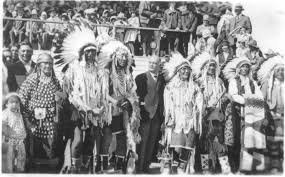
1824 - Creation of the BIA (Bureau of Indian Affairs)
1830 - Indian Removal Act
July 1845 - phrase "Manifest Destiny" is coined
1851 - Indian Appropriations Act (allocating funds to move to Western reservations)
1864 - Sandy Creek Massacre
1871 - rider to Indian Appropriations Act: no recognition of additional Native tribes or subsequent treaties
1876 - Battle of Little Big Horn
1890 - Sitting Bull is killed; Wounded Knee Massacre
1907 - Charles Curtis becomes the first Native American US Senator (will later become vice-President in 1929)
mid 20th century: federal policies aimed to dissolve tribal status and move Native people into cities, producing dislocation - indeed, these were so-called termination policies— but also intertribal urban networks; meanwhile the repressed anger of Native Americans found activist echoes in the Civil Rights and Black Power movement, fueling the emergence of a "Red Power Movement"
1961: American Indian Chicago Conference and Declaration of Indian Purpose
1968 - Indian Civil Rights Act by President Lindy Johnson, proposes that "termination" be replaced by "self-determination" but authorizes governmental agency over the jurisdiction of the tribes, in order to protect individual Indians from arbitrary and unjust actions of tribal governments." This creates resentment.
In 1968, also, the AIM (American Indian Movement) is founded.
1969: Occupation of Alcatraz; Scott Momaday's House Made of Dawn wins the Pulitzer Prize and great visibility is given to. Native-American Renaissance: read more about it here http://nativeamericanlit.com/
[see powerpoint on moodle for more details on the Red Power Movement and the Native-American Renaissance]
and finally, one century's most well-known Native American writer (Sherman Alexie) — see what he has to say about his tradition:
To situate "Storyteller" and the groundbreaking work of the same title that launched Leslie Marmon Silko as a major US writer, you might want to know a little about the emergent acknowledgment of native-American literature in the native-American Renaissance (a controversial though widespread term) here: https://nativeamericanlit.com/.
As you read "Storyteller", please take your time to comment on one or more of these topics:
- intertwined narratives - Focalization - Description of natural elements - Dramatization of cultural mediation and conflict