Saturday, 9 May 2026

HW for May 13-25: Allen Ginsberg (anthology, pp. 163-169) and Anne Waldman (pp. 174-182)

 1. Read the poem "America" and listen afterwards to this partial recording. Were you surprised by this rendition? Speculate, highlight lines, etc, on the difference between your inner reading and the performative one.


2. Read Ginsberg's "The Little Fish deouvrs the Big Fish" and then Waldman's "History will decide". What strikes you about the transnational dimension of these texts? In what ways do they relate to an imperialistic drive of the US that connects with some of the themes of the previous diasporic authors you read in the class? (do not forget, again, this is a literature class- so point to concrete lines you might analyze). 

Wednesday, 6 May 2026

Monday, 4 May 2026

HW for May 6: The Mandarin Qustion, by Katherine Vaz

  Answer to either or both:

- This short story is based on the Mandarin Paradox, posed in 1802 by the French writer and philosopher François-René Chateaubriand, and later retaken by Eça de Queirós in his novel "The Mandarin". Look at the qoute by Chateaubriand, as he phrased the paradox, and relate it briefly to at least two diasporic texts read in the class (including, of course, the one by Vaz): 

I ask my own heart, I put to myself this question: "If thou couldst by a mere wish kill a fellow-creature in China, and inherit his fortune in Europe, with the supernatural conviction that the fact would never be known, wouldst thou consent to form such a wish?" (Chateaubriand, 1802)

- Synesthesia has become a stylistic mark for Katherine Vaz. Where do you find it in the story and what are its effects?


Sunday, 3 May 2026

Portuguese-Americans in the US


Dighton Rock


  • Early 1500s–1542: Portuguese navigators/explorers are linked (in the text) to early contact with North American shores; João Rodrigues Cabrilho is noted as the first European to reach California (1542). Miguel Corte-Real may have been in the East Coast in the early 16th C 
  • 1634: First documented Portuguese resident in colonial America: Mathias de Sousa
  • Peter Francisco, "giant soldier" in the continental army, said to be from the Azores

Wave 1 — 1840s: the whaling corridor into New England

  • Main driver / mechanismWhaling voyages served as a route to America; whalers frequently stopped in the Azores to recruit crew, and many crew members later settled when ships docked in New England.
        GeographyNew Bedford, Massachusetts (described as the whaling center by the early              19th century), alongside older whaling areas like Nantucket and Cape Cod

Wave 2 — Late 1890s: Azorean and Madeiran community-building in industrial and coastal New England

  • Where (core clusters):
  • Rhode Island: Tiverton, East Providence, Valley Falls, Pawtucket
  • Southeastern Massachusetts: Taunton, Brockton, Fall River, New Bedford
  • Also: Lowell and Lawrence (Northern MA), Southern New Hampshire, and neighborhoods in Boston (East Boston, North End), plus Cambridge and Somerville.
Why those places: Availability of low-skill work, particularly in the textile industry, accessible to newcomers with limited English

Wave 3 — From Capelinhos (1957–58) through the Immigration Act of 1965 and after

  • 1957–58Capelinhos volcano eruption (Faial, Azores) causes major destruction and displacement.
  • 1958Azorean Refugee Act signed, granting 1,500 visas to victims; extended in 1962.
  • After WWII into this period: Another migration wave noted especially to the Northeast (NJ, NY, CT, RI, MA, MD) and California, including people described as fleeing the Salazar dictatorship; growth of Portuguese clubs for cultural preservation.
  • 1965Immigration and Nationality Act allows legal residents to sponsor family members, described as dramatically increasing Portuguese immigration into the 1970s and 1980s.

Snapshot by 2000

  • 2000 U.S. census (as quoted in the text)1,176,615 Portuguese-Americans, described there as mostly of Azorean descent (the excerpt itself flags that point as needing a citation)

Friday, 1 May 2026

HW for May 4 (anthology, pp. 144-147)

  Answer either or both:

1. Compare the poem "The Genetics of Leaving" and its treatment of the matters of language and memory with any other text read in this class.

2. Choose a favorite poem and try to pinpoint what interests you in it and how does the work on language contribute to enhance your attention.


3. Listen here to Etheridge Knight, research, and speculate on the operation of imitation or parody that Barbosa is doing in her "Welcome Back": https://soundcloud.com/robert-elijah-nesbitt/welcome-back-mr-knight-love-of

Here is the link to the author's page: https://www.shaunabarbosa.com/

Monday, 27 April 2026

HW for April 29: Tessa Hulls, "Feeding Ghosts"

 Answer one or more:

- How does the autobiography serve the telling of this diasporic narrative(s)?

- The flashback history journey that the autobiographical subject decides to embark in takes her through moments of Chinese and of Japanese history. How do these flashback journeys affect what you alresdy knew about Asian-American diaspora in the US?

- Choose the following or any other page (recording its number) to analyse in terms of text (close-reading) and image composition.


Wednesday, 22 April 2026

Gloria Anazldúa - Borderlands / La Frontera (HW for April 27)

 The concepts of hybridity and border space presented by Gloria Anzaldúa in Borderlands: La Frontera / The New Mestiza (1987) are considered key themes in postcolonial studies., (ver aqui: http://www.qub.ac.uk/imperial/key-concepts/Hybridity.htm) and these can be related with "Third Space of enunciation" defined by Homi Bhabha in The Location of Culture (1995).


"The intervention of the Third Space, which makes the structure of meaning and reference an ambivalent process, destroys this mirror of representation in which cultural knowledge is continuously revealed as an integrated, open, expanding code. Such an intervention quite properly challenges our sense of the historical identity of culture as a homogenizing, unifying force, authenticated by the originary Past, kept alive in the national tradition of the People. In other words, the disruptive temporality of enunciation displaces the narrative of the Western nation (...) as being written in homogeneous, serial time.
It is only when we understand that all cultural statements and systems are constructed in this contradictory and ambivalent space of enunciation, that we begin to understand why hierarchical claims to the inherent originality or “purity” of cultures are untenable, even before we resort to empirical historical instances that demonstrate their hybridity."
Homi K. Bhabha.

Find and comment on examples of hybridity (in textual structure, narrative voice, themes addressed, and reproduced discourses) in the chapter of Borderlands to be read in class, and comment briefly on them.

Monday, 20 April 2026

HW for April 22: Linda Hogan's texts in dialogue with Gary Synder's "Unnatural Writing"

 In the essay “Unnatural Writing,” Gary Snyder proposes a few topics for a “New Nature Poetics.” Consider the following recommendation for an “art of the wild” — “That it study mind and language—language as wild system, mind as wild habitat, world as a ‘making’ (poem), poem as a creature of the wild mind” (p. 172, essay / p. 127 course anthology).

How can we relate Snyder’s invitation with Linda Hogan’s assertion in “Walking” — “I never learned the sunflower’s golden language or the tongues of its citizens. (…) But they knew what to do, how to live.” (p. 157, book / p. 115 course anthology).

    (image Chris Pappan, ‘Atom Heart Mother (Hearth)’, 2016, reproduced from https://www.nga.gov/exhibitions/land-carries-our-ancestors-contemporary-art-native-americans)

Monday, 13 April 2026

HW for April 15: Laily Long Soldier, poem 38, pp. 49-53

Choose one or mor 

1. Is this a poem? What to make of the first line: "Here, the sentence will be respected?"

2. Relate the poem to the book cover below


3. If you have studied Walt Whitman's "Song of Myself" in Leaves of Grass, can you establish any connection between the ending of "38" and these lines from section 52 of Whitman's poem? 

“I bequeath myself to the dirt to grow from the grass I love.

If you want me again look for me under your boot-soles” (1338-39).

Monday, 6 April 2026

Guidelines for final project

 Your final project is a literary analysis project worth 25% of your grade, broken down into:

  • 5% for the plan/proposal (your 300-word handwritten rationale by April 24)

  • 10% for the process (your May 13 draft with about two-thirds of the paper)

  • 10% for the final result (the June 1 submission, up to 2000 words)

What You Have to Do

  1. Choose a primary literary text from your syllabus — but not the one you used for your oral presentation.

  2. Select a major critical or theoretical text that engages with that literary work and a theme or question that interests you in it (for example, an essay, critical theory, or scholarly article researched in google scholar).

  3. Summarize the critical author’s argument (what they say about the text and how they interpret it).

  4. Respond to that critical perspective — using your understanding of both the primary text and the critical framework — to develop your own short analysis or argument.

  5. Keep everything within 2000 words maximum.

The Rationale (for April 24)

You’ll need to handwrite a 300-word justification explaining:

  • Why you chose this particular text and critic.

  • What angle or question you want to explore.

  • How this project connects to your interests or course themes.

AI Use and Academic Integrity

AI tools are discouraged for environmental reasons but their use as an auxiliary is not forbidden.
You may use them if you cite the assistance properly using APA’s guideline for generative AI citations (e.g., Perplexity, powered by GPT-5, chat on plan proposal for final assignment, April 2026, https://www.perplexity.ai/search/25-5-plan-proposal-10-process-HiAddwVBQ8qTZeF1Au0MRA).
Also, your text should remain primarily your own: less than 35% AI-typical phrasing (which the teacher will verify with an IA-pattern recognition tool)


Sunday, 5 April 2026

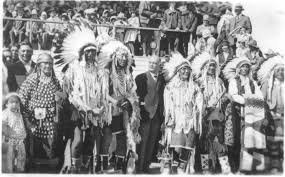
Native-Americans in the US: Key Dates leading to "Red Power" and "Native-American Renaissance"


1824 - Creation of the BIA (Bureau of Indian Affairs)

1830 - Indian Removal Act

July 1845 - phrase "Manifest Destiny" is coined

1851 - Indian Appropriations Act (allocating funds to move to Western reservations)

1864 - Sandy Creek Massacre

1871 - rider to Indian Appropriations Act: no recognition of additional Native tribes or subsequent treaties

1876 - Battle of Little Big Horn

1890 - Sitting Bull is killed; Wounded Knee Massacre

1907 - Charles Curtis becomes the first Native American US Senator (will later become vice-President in 1929)


mid 20th century: federal policies aimed to dissolve tribal status and move Native people into cities, producing dislocation - indeed, these were so-called termination policies— but also intertribal urban networks; meanwhile the repressed anger of Native Americans found activist echoes in the Civil Rights and Black Power movement, fueling the emergence of a "Red Power Movement"

1961: American Indian Chicago Conference and Declaration of Indian Purpose

1968 - Indian Civil Rights Act by President Lindy Johnson, proposes that "termination" be replaced by "self-determination" but authorizes governmental agency over the jurisdiction of the tribes, in order to protect individual Indians from arbitrary and unjust actions of tribal governments." This creates resentment.
In 1968, also, the AIM (American Indian Movement) is founded. 

1969: Occupation of Alcatraz; Scott Momaday's House Made of Dawn wins the Pulitzer Prize and great visibility is given to. Native-American Renaissance: read more about it here http://nativeamericanlit.com/

[see powerpoint on moodle for more details on the Red Power Movement and the Native-American Renaissance]

and finally, one  century's most well-known Native American writer (Sherman Alexie) — see what he has to say about his tradition:

Thursday, 2 April 2026

HW for April 8: Leslie Marmon Silko, "Storyteller" (anthology, pp. 67-86)

 To situate "Storyteller" and the groundbreaking work of the same title that launched Leslie Marmon Silko as a major US writer, you might want to know a little about the emergent acknowledgment of native-American literature in the native-American Renaissance (a controversial though widespread term) here: https://nativeamericanlit.com/.

As you read "Storyteller", please take your time to comment on one or more of these topics:

- intertwined narratives
- Focalization
- Description of natural elements
- Dramatization of cultural mediation and conflict


Wednesday, 18 March 2026

HW for March 23 - Hai Dang Phan's poems (anthology, pp. 59-66)

 For next class, we will have a guest teacher, Maria Caroliina Vaz de Almeida, who has kindly prepared these questions for you:


1. In a 2021 article, Hai-Dang Phan mentions the centrality of An-My Lê’s photography to his poetry, remarking that it has allowed him to “reckon with my own thoughts and feelings toward war and conflict, dislocation and exile–and above all toward our shared experience of leaving Vietnam as refugees and growing up in the United States.” Succinctly, An My-Lê’s photography can be interpreted in light of thetransposition of time and space from the Vietnam War into the American landscape through the civil reenactments of the war. Either:

a) Select and comment on one of An-My Lê’s photographs from the collection Small Wars (1999-2002), which you can find here: Small Wars — An-My Lê.

b) Discuss Hai-Dang Phan’s poem “Small Wars” in comparison with An-My Lê’s photograph entitled Rescue (for example, the significance of usingdifferent artistic mediums, the continual process of reenactments, the use of rhetorical devices like Ekphrasis, or others).You can find Phan’s article here, if you would like to read it: Speak, Reenactment | Hai-Dang Phan.

2. Hai-Dang Phan’s work also engages with the turmoil of adopting and writing in the language rooted in the cause of the exodus, seeking to connect geographical dismembering with linguistic disruption. “My Father’s Norton Introduction to Literature, Third Edition (1981)” incorporates and quotes directly from multiple sources of the American and English literary tradition. Either:

a) Identify one of the poems, short stories, or plays referenced in the poem and discuss its significance within the context of Phan’s poem.

b) Comment on the poem’s dialogue with the American and English literary tradition, namely, how the linguistic and literary hybridization further challenges the boundaries of national literature.

phtos by An-My Lê

Monday, 16 March 2026

HW for March 18: poem "Some Day I'll Love Ocean Wong"

 1. Read about Wong's life story here https://www.theguardian.com/books/2017/oct/03/ocean-vuong-forward-prize-vietnam-war-saigon-night-sky-with-exit-wounds and relate it to elements in the poem.

2. Do a close-reading analysis of the poem, with special focus on dectics, verb forms, and apostrophe.

                                         (photo by Ocean Vuong from the exhibit depicted here https://www.anothermag.com/art-photography/16914/ocean-vuong-photography-show-interview-grief-song-cpw-kingston)

Wednesday, 11 March 2026

HW for March 16 (and 18) - Talking with Ahmad Almallah and "Fuck you" poem

 1. Think of questions you would like to ask Ahmad Almallah (they can be questions about his situation as Palestinian-American, about the endurance of genocide, about his poetry, about being a poet...)

2. Create your own "fuck you" poem of 14 lines relating what you have learnt and read so far  to the contents of this class (if you prefer, you can put the poem in one of the characters' voice, e. g. "the son" in Symbols and signs). Some exampes of possible first lines

Fuck you to "welcome"  and to coming back

Fuck you Acme Beer. We will never reach the hill.

Fuck you golden door. My people came to sweep the floor.

Fuck you Riviera. Jesus this is Gaza.

Fuck you to the line break. We don't get breaks between classes

etc.


Facts about Palestinian-Americans

 Palestinian Americans are Americans with Palestinian ancestry, forming part of the broader Arab American community. 


  • Early presence: Small numbers from “Greater Syria” (Ottoman-era Levant) immigrated to the U.S. in the late 19th/early 20th centuries; people later identified specifically as Palestinian as national identities crystallized. 


  • Major migration waves: Larger inflows followed key upheavals in Palestine/Israel, especially mid‑20th century onward. There are around 160 000 Palestinians in the US (0,05% of the population), according to the 2023 American Community Survey


  • The Nakba (1948): Arabic for “catastrophe”; refers to the mass displacement and dispossession of Palestinians during/around the 1948 war and the establishment of Israel, followed by the Arab-Israeli War. This event created a large refugee diaspora.


  • Six-Day War / June War (1967): A June 1967 war in which Israel captured the West Bank (including East Jerusalem) and Gaza, among other territories; it triggered another displacement wave often called the Naksa (“setback”), further expanding diaspora communities. References. Greater quantities than before fled to the US because of the1965 Immigration and Nationality Act.


  • Community geography in the U.S.: Palestinian Americans are concentrated in certain metro areas (like the NYC/NJ area, Chicago region, parts of California, Florida, Michigan, and others), reflecting chain migration and family networks. 


  • Religion and diversity: The community includes Muslims and Christians (and smaller numbers of others), and is internally diverse by region-of-origin, class, and migration story. 


  • Civic and cultural life: Palestinian Americans have built institutions (community groups, cultural organizations, student associations, advocacy organizations) and are active in U.S. civic life. 


  • Post–Oct 7, 2023 situation: On October 7, 2023, the Palestinian nationalist and Islamist movement Hamas orchestrated a terrorist attack upon Jewish festival-goers, killing 1200 people. Israel then launched a massive counter-offensive, which continues to this day (despite two "cease-fires) and has killed 75000 Palestinians to date - which has been recognized by many international committees has a genocide (incluidng the UN Independent International Commission of Inquiry and Amnisty International). This intensified among Palestinian-Americans grief for family in Gaza/Palestine. They expanded political organizing and protest, but there is also heightened fear of harassment and social/professional repercussions.


Images from the work of comics journalism by Joe Sacco, Palestine (1993)